Platform Overview

See how OmniARP correlates signals and executes controlled remediation.

This deep dive maps cross-layer reasoning from database engines to Kubernetes and core infrastructure operations.
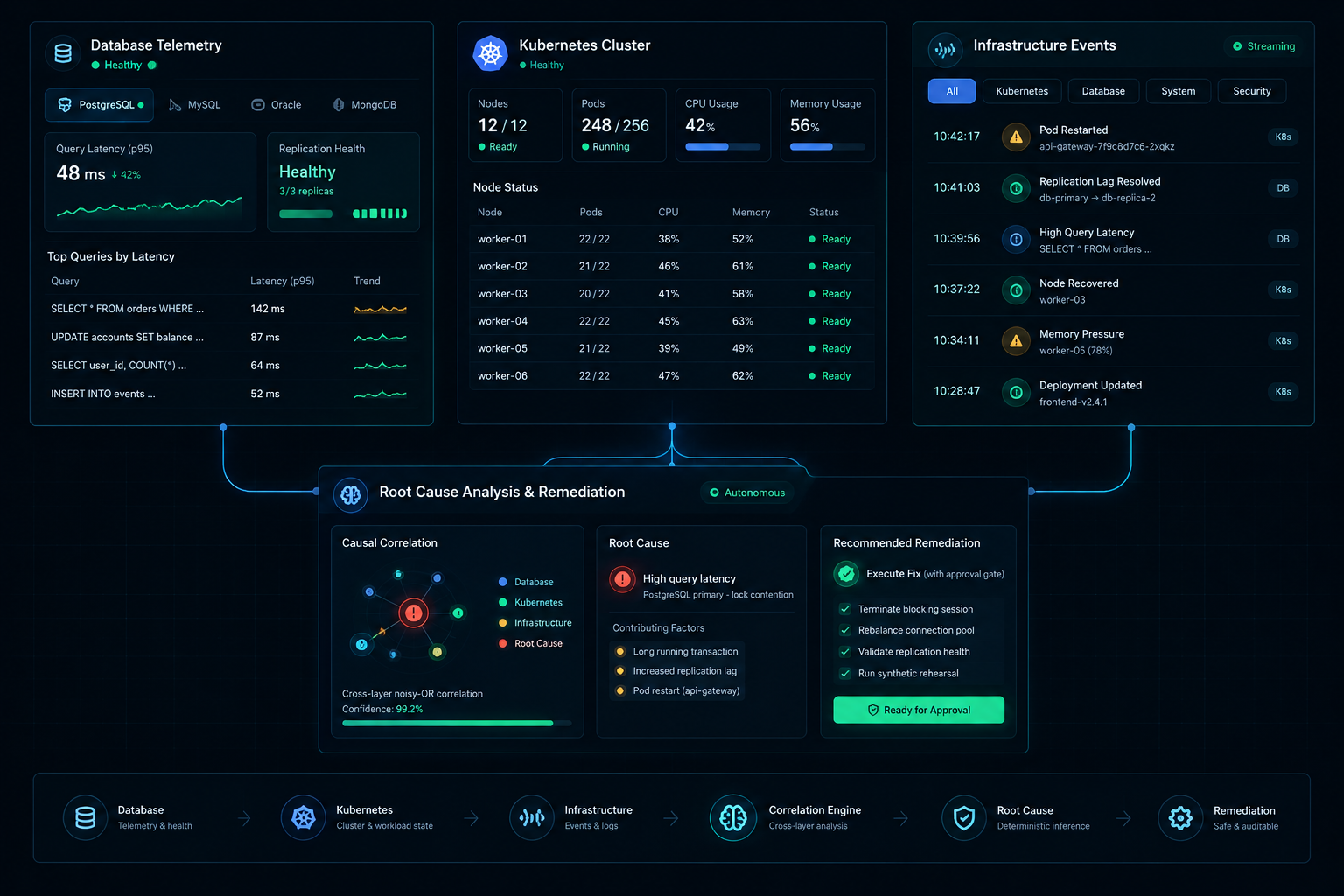
Dark enterprise product composition showing cross-layer signal correlation between databases, Kubernetes clusters, and infrastructure telemetry with remediation status indicators

Platform pillars

Six operating verbs for governed autonomous reliability

A modular control-plane map of the platform: each capability is compact, auditable, and built for fast technical evaluation.

See

Bring dispersed operational signals into one decision-ready surface.

Correlate

Trace relationships across symptoms instead of treating every alert as a separate incident.

Rehearse

Validate a proposed fix before it reaches production risk.

Approve

Route high-impact action through explicit governance checkpoints.

Act

Move with controlled execution once evidence and approvals align.

Audit

Preserve a defensible record of decisions, approvals, and outcomes.

Fix Studio workflow

Remediation is rehearsed, reviewed, and controlled before production touch.

A four-step path that keeps AI recommendations observable, auditable, and deterministic at every gate.

  1. Stage 01 · Issue analysis

    Cross-layer signal triage with explicit cause candidates.

    • • Correlates Kubernetes, database, and infra telemetry with noisy-OR logic.
    • • Surfaces confidence, blast radius, and impacted services before any action.
    analysis.console observing

    root-cause candidate: lock-wait saturation on db-cluster-03

    linked signals: pod restart spike · queue latency +37%

    estimated blast radius: payments-write-path

  2. Stage 02 · Synthetic clone rehearsal

    Run the fix in a mirrored environment first.

    • • Replays production incident context against synthetic workload clones.
    • • Verifies rollback path, latency impact, and policy boundaries pre-release.
    rehearsal.runbook sandbox clone

    scenario

    txn-load: p95 +28%

    result

    error-rate: -91%

    rollback check

    deterministic path validated ▍

  3. Stage 03 · Governed approval

    Human gate with role-bound policy enforcement.

    • • Requires designated approvers with change-ticket and risk context attached.
    • • Stamps cryptographic audit trail for compliance-ready evidence packs.
    approval.gate awaiting sign-off

    Change ticketINC-48271

    Approver policySRE + Risk

    Audit hashsha256:7f3...a9c

  4. Stage 04 · Controlled execution

    Apply with deterministic fallback and live guardrails.

    • • Executes only approved remediation steps inside bounded runtime policies.
    • • Auto-triggers predefined fallback sequence if health signals regress.
    execution.guardrail policy-bound

    step 1: patch connection pool limit

    watch: p95 latency · lock wait · replica lag

    fallback: restore previous config in < 12s

Deployment models

Evaluate in your environment without compromising control

Compare practical deployment paths side by side and validate governance, performance, and operational fit before production rollout.

Deployment path

Standard enterprise rollout

  • Launch inside a controlled Linux-based environment with an operational footprint teams can evaluate quickly.
Deployment path

Private and regulated environments

  • Keep the platform inside customer-controlled boundaries for security-sensitive infrastructure.
Deployment path

Pilot to production path

  • Start with a practical evaluation, then expand into wider operational coverage once teams approve the model.